Ford Ranger Raptor Horsepower Overview: What makes the Raptor Stand Out
The Ford Ranger Raptor isn’t just another trim level bolted onto a midsize truck. Under the hood sits a twin-turbo 3.0L EcoBoost V6 that pushes horsepower well beyond anything else in the Ranger lineup. If you’re weighing whether those numbers translate into real driving advantages, the engine details below lay out exactly what you’re getting behind the wheel. Curious what’s currently on our lot? You can browse our Ranger Raptor inventory anytime.
Ford Ranger Raptor Horsepower at a Glance
The 2026 Raptor produces 405 horsepower and 430 lb-ft of torque, the most horsepower of any midsize truck on the market according to Kelley Blue Book (KBB). These figures directly affect towing confidence, throttle response, and how the truck handles rougher terrain around Birmingham and beyond. The Raptor isn’t chasing horsepower for bragging rights alone. Every figure ties back to how the truck performs when pavement runs out.
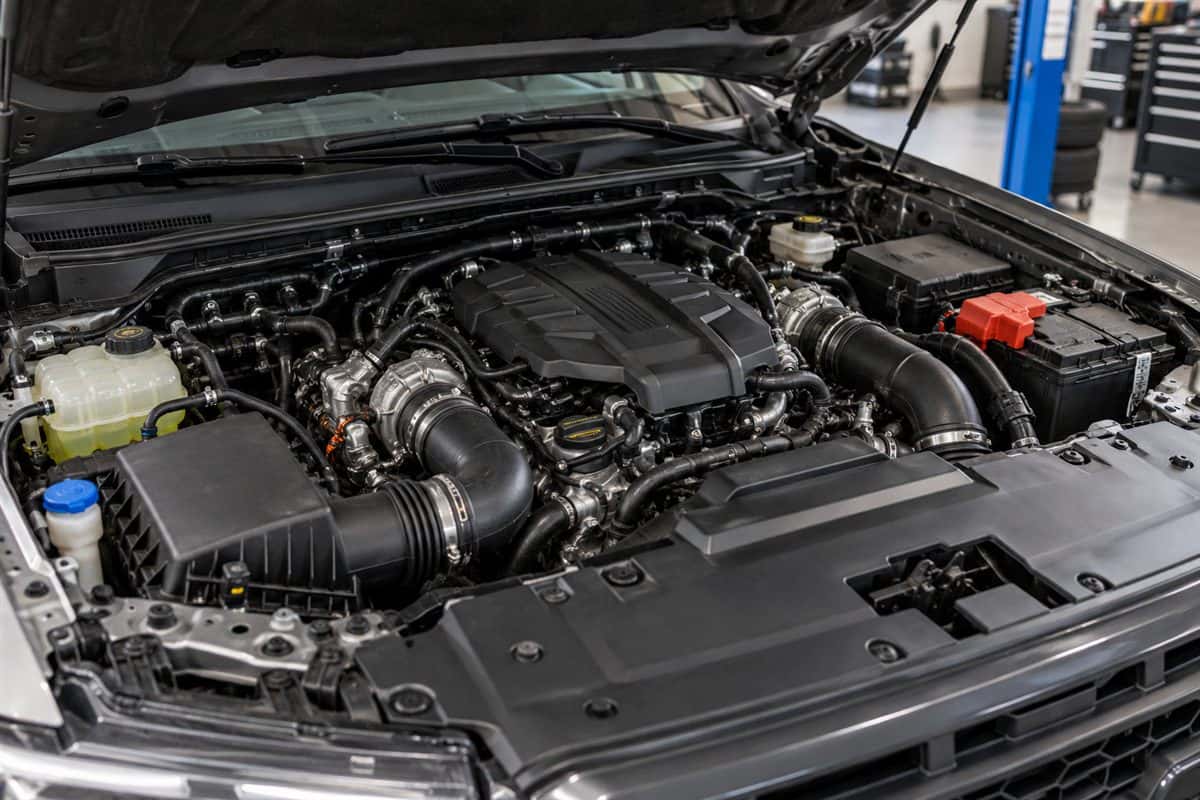
The High-Output EcoBoost V6 Engine
The Raptor’s engine is a 3.0-liter block, but displacement alone doesn’t tell the story. Ford’s engineers paired it with twin turbochargers, extracting far more output than the Ranger’s other available engines. What you get is a powertrain built specifically for performance rather than pure utility.
Horsepower and Torque Figures Explained
Horsepower gets the headlines, but torque does the heavy lifting. The Raptor’s 430 lb-ft arrives around 3,500 RPM, giving it strong low-end pull for climbing grades, hauling gear, or powering through soft sand. The EPA rates the Raptor at 16 mpg city, 18 highway, and 17 combined, which is the trade you make for that output and the 33-inch tires underneath it. Horsepower sets the ceiling on top speed and passing punch, but torque is what you feel first, whether that’s merging onto the highway or crawling over rocks.
How the Raptor’s Engine Differs From Standard Ranger Trims
Ford offers three distinct engine options across the broader Ranger lineup, though only one belongs to the Raptor itself. The XL, XLT, and Lariat trims come standard with a 2.3L EcoBoost turbo-4 producing 270 hp and 310 lb-ft, with rear-wheel drive standard and 4WD available. XLT and Lariat models offer an optional 2.7L EcoBoost V6 rated at 315 hp and 400 lb-ft. The Raptor’s 3.0L EcoBoost V6 sits above both and comes with 4WD standard, purpose-tuned for performance rather than everyday efficiency.
| Engine/Powertrain | Horsepower | Torque | Transmission | Drivetrain |
|---|---|---|---|---|
| Raptor 3.0L EcoBoost V6 (twin-turbo) | 405 hp | 430 lb-ft | 10-speed automatic | 4WD standard, locking front and rear axles |
| XLT/Lariat 2.7L EcoBoost V6 (optional) | 315 hp | 400 lb-ft | 10-speed automatic | RWD standard, 4WD available |
| XL/XLT/Lariat 2.3L EcoBoost turbo-4 (standard) | 270 hp | 310 lb-ft | 10-speed automatic | RWD standard, 4WD available |
Power Delivery: Transmission and 4WD System
Every Ranger, Raptor included, routes power through a 10-speed automatic transmission. What separates the Raptor is how that transmission works alongside its 4WD hardware and drive mode software to actually put the extra horsepower to use.
10-Speed Automatic Transmission and Drive Modes
The Raptor offers seven selectable drive modes, including Baja mode, tuned specifically for high-speed off-road running. Baja mode holds gears longer, sharpens throttle response, and dials back stability-system intervention so the suspension can move more freely over rough terrain. A 12-inch center screen displays whichever mode is active, and a programmable steering-wheel button lets drivers save their preferred settings for quick access.
Selectable 4WD and Locking Differentials
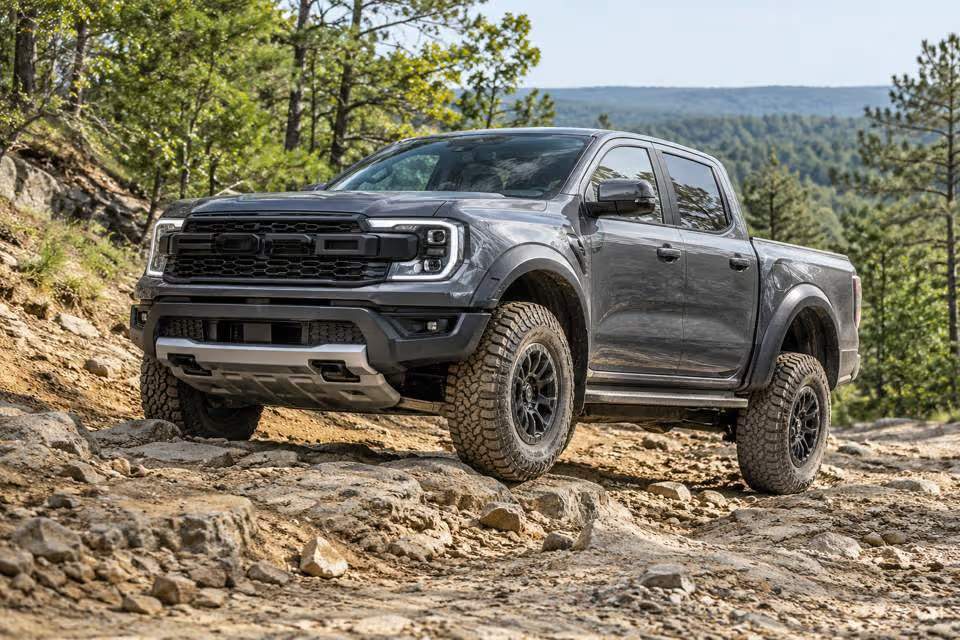
The Raptor comes standard with 4WD and locking front and rear axles, a clear step up from XL, XLT, and Lariat trims, where 4WD is optional and the locking hardware stops at the rear axle. Being able to lock the front as well as the rear, paired with 33-inch all-terrain tires, gives the Raptor’s 4×4 system real traction advantages when conditions get loose or uneven.
For drivers exploring regional trails within an hour of Birmingham, that difference matters when packed dirt suddenly turns into loose gravel. If you’re weighing what that capability is worth to your budget, you can explore financing options before your visit.
Baja-Inspired Off-Road Engineering
Ford didn’t build the Raptor’s chassis and suspension in isolation. The engineering pulls directly from desert racing, and the Raptor backed that pedigree up before it ever reached showrooms: a pre-production truck won the stock mid-size class at the Baja 1000, finishing the course in 26 hours and 21 minutes and then driving nearly 200 miles home from the finish line.
FOX Performance Suspension and Ground Clearance
FOX Racing Shocks with Live Valve Technology sit at every corner, using 2.5-inch internal-bypass dampers that adjust continuously to soak up impacts at speed. Up front, a forged aluminum double A-arm setup improves wheel travel, while the rear swaps Lariat’s leaf springs for a Watts-link setup with trailing arms and coil springs. Ground clearance measures 10.7 inches, and the Raptor’s wider track improves stability at speed over rough ground. Approach angle reaches 33 degrees and departure angle 26.4 degrees, both improvements over standard Ranger trims.
Reinforced Chassis and All-Terrain Tires
The frame carries reinforced elements and aluminum control arms to handle the stress of high-speed off-road driving, paired with a wider track for added stability. Off-road capability also comes down to rubber: 33-inch BFGoodrich KO3 all-terrain tires mounted on 17-inch wheels, with optional beadlock-capable wheels for serious off-roaders. Steel front and rear bumpers round out the truck’s ability to handle impacts that would dent a standard Ranger.
Real-World Performance Behind the Numbers
Numbers on a spec sheet only matter if they hold up on the road or trail, and the Raptor’s output backs itself up once you’re actually driving.
Acceleration and Passing Power
Car and Driver put a 2026 Ranger Raptor on its test track at the start of a 40,000-mile long-term test and recorded 5.2 seconds to 60 mph, a quarter-mile of 13.9 seconds at 98 mph, and a 50-to-70-mph top-gear pull of 4.1 seconds. That 0-60 result matches the 450-hp F-150 Raptor, which is a remarkable number for a truck two feet shorter and considerably cheaper. Testing conditions and surfaces move these figures around, so treat them as a benchmark rather than a promise, but either way the Raptor lands well ahead of standard Ranger trims. Much of that responsiveness comes from an anti-lag turbo system that keeps the turbochargers spinning for up to three seconds after you lift off the throttle, so power delivery stays instant rather than lagging when you need it again.
Climbing, Trail Driving, and High-Speed Off-Road Capability
Strong low-end torque and quick throttle response make merging and passing on regional highways straightforward, while Baja mode shifts the truck’s personality entirely once you’re off pavement. Locking differentials keep power flowing to wheels with traction, and the reinforced suspension lets the Raptor maintain speed over terrain that would rattle a standard truck. Whether you’re climbing a rutted grade or running wide open across flat desert-style terrain, the 0-60 numbers only tell part of the story. It’s the sustained performance over miles of rough ground that sets this truck apart.
Experience the Ford Ranger Raptor at Stivers Ford of Birmingham
Why Visit Us
Reading about horsepower figures only goes so far. Come see the 3.0L EcoBoost V6 and FOX suspension in person, and compare the Raptor side-by-side with XL, XLT, and Lariat trims to get a much clearer picture of what you’re getting.
Schedule Your Test Drive
When you’re ready to feel the acceleration and off-road capability for yourself, contact our team to schedule a test drive at Stivers Ford of Birmingham.
0 comment(s) so far on Ford Ranger Raptor Horsepower Overview: What makes the Raptor Stand Out