
How to Use Ford Adaptive Cruise Control on 2026 Ford Trucks
Long highway drives and stop-and-go commutes wear on you in different ways, but they both take a toll. Ford Adaptive Cruise Control eases both situations, helping you stay safe and comfortable without demanding constant input behind the wheel. Hauling a load on I-65 or crawling through downtown Birmingham traffic feels different behind the wheel, but understanding how this system works on your 2026 Ford truck can change the way you drive in either case. Browse our new vehicles to see it in person, or keep reading to learn how it works.
Understanding Ford Adaptive Cruise Control
Ford Adaptive Cruise Control (ACC) is a driver-assistance technology that automatically manages your truck’s speed based on what’s happening ahead of you. Using radar sensors and onboard cameras, it continuously monitors the road and the vehicles in front of you. It eases off your speed when traffic slows down, then brings you back to your preset cruising speed on its own once the road clears.
How It Differs from Standard Cruise Control
Standard cruise control holds a fixed speed no matter what’s happening in front of you. Ford Adaptive Cruise Control instead maintains a preset distance from the vehicle ahead, slowing and resuming automatically as traffic conditions change. That difference shows up most in moderate highway traffic, such as an I-459 commute, where speeds shift constantly. Rather than flipping cruise control on and off every few minutes, ACC absorbs those fluctuations for you.
Setting Up and Using Adaptive Cruise Control
Getting started with Ford Adaptive Cruise Control doesn’t take long, and most drivers pick it up quickly, even with no prior ACC experience.
Activating the System and Setting Your Speed
Start by selecting Driver Assist on the instrument cluster using the five-way steering wheel controls. From there, select Cruise Control and choose Adaptive. Press the On button on the cruise control switch, drive to your desired speed, then press and release Set+ and take your foot off the accelerator.
That Set+ press is the step people skip. Reaching your speed doesn’t lock it in on its own. Your instrument cluster confirms the system is active and displays your current set speed once it’s engaged.
Adjusting the Following-Distance Gap
Ford’s ACC lets you control how much space it keeps between your truck and the vehicle ahead, with four following-distance levels shown as bars on your display. One bar keeps the closest gap, four bars gives you the most room, useful for low-traction conditions. Toggle between them using the gap button on the steering wheel, so you can adjust mid-drive without getting distracted.
One thing worth understanding: the gap setting is time-based, not distance-based, so the physical space adjusts with your speed. Two bars at 30 mph is a much shorter gap than two bars at 70. The system also remembers your last setting each time you switch it on.
Using Stop-and-Go in Traffic
Stop-and-Go takes Ford Adaptive Cruise Control a step further for anyone dealing with congested roads. When traffic grinds to a complete halt, the system brings your truck to a full stop, down to 0 mph, with no intervention needed.
Here’s the part that matters. If the vehicle ahead starts moving again within about three seconds, your truck follows automatically. If it sits longer than that, the system stands down and you press RES on the steering wheel to pick things back up. So Stop-and-Go handles the crawl of congested traffic beautifully, but a long red light means you’re taking over. For daily commuters navigating downtown Birmingham, knowing where that line sits is what makes the feature genuinely useful rather than a surprise.
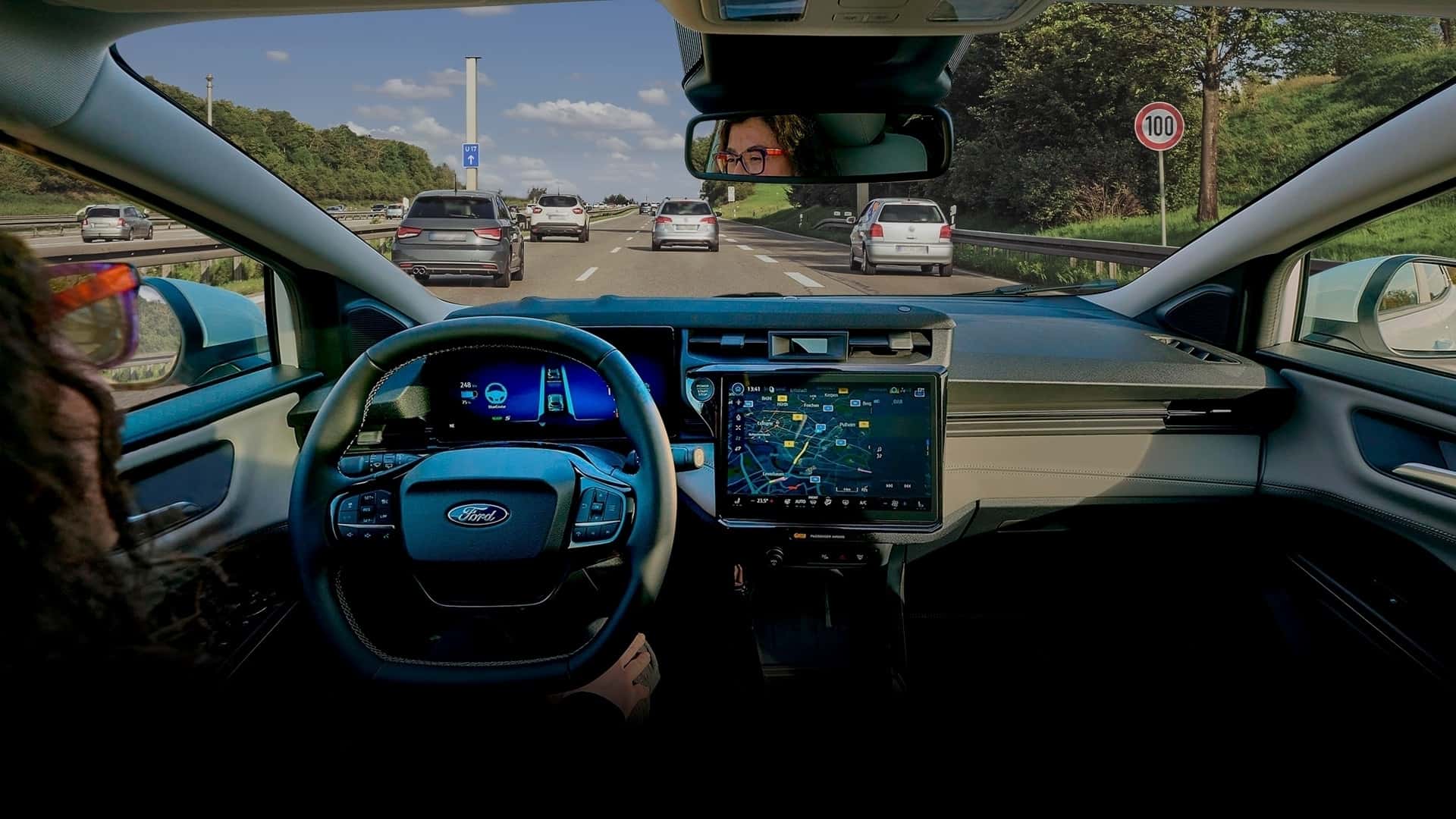
Adaptive Cruise Control on the 2026 Ford F-150
The 2026 F-150 includes Adaptive Cruise Control as part of Ford Co-Pilot360 Assist 2.0. It’s standard on Lariat, Tremor, King Ranch, Platinum, and Raptor trims, and available on the XLT through the Mid (302A) and High (303A) equipment packages.
The F-150 also supports Ford BlueCruise hands-free driving on approved highways, adding another layer of convenience for long-haul drivers. It’s available on Platinum, King Ranch, Lariat, Tremor, and select XLT models.
Adaptive Cruise Control on the 2026 Ford Ranger
Adaptive Cruise Control with Speed Sign Recognition comes standard on the Ranger Lariat (500A) and Raptor (800A). On the XLT (300A), it arrives through either the Technology Package or the Advanced Towing Package Plus Technology Package, which also bring a 360-Degree Camera and Front Parking Sensors.
Speed Sign Recognition is what separates this from ordinary cruise control. The system reads posted speed limit signs and adjusts your set cruise speed to match, which matters on the kind of drive where limits change every few miles.
Ranger drivers running a mix of city streets and highway will get the most out of it, since the system holds a safe following distance through the frequent speed changes that come with urban driving. Note that Lane-Keeping System and Pre-Collision Assist with Automatic Emergency Braking are separate features, standard across the Ranger lineup as part of Ford Co-Pilot360, so you don’t need the ACC package to get them.
Adaptive Cruise Control on the 2026 Ford Maverick
Adaptive Cruise Control comes as part of Ford Co-Pilot360 Assist 2.0, standard on the Maverick Lariat and Tremor, and available on the Maverick Lobo. It is not offered on XL or XLT at any price, so if ACC matters to you, the Lariat is your entry point.
The package bundles Adaptive Cruise Control with Stop-and-Go, Lane Centering, and Predictive Speed Assist. Stop-and-Go brings the truck to a full stop in traffic and resumes when it clears. Lane Centering keeps you positioned between the lines. Predictive Speed Assist adjusts your speed as you approach curves, which is a different thing from reading speed limit signs and worth understanding before you set expectations.
Commuters running Birmingham’s downtown stop-and-go will get real use out of it, since holding a following distance through repeated slowdowns is exactly the work this system was built for.
Safety Limitations and When to Take Manual Control
Ford Adaptive Cruise Control assists your driving. It doesn’t replace your judgment, and there are situations where its capabilities hit practical limits.
The system may disengage in heavy rain, fog, snow, or when lane markings are unclear. It cannot reliably detect stationary objects, emergency vehicles, or pedestrians outside sensor range. In construction zones, sharp curves, or unpredictable traffic, take manual control. Ford’s driver-assistance features exist to support attentive driving, not replace it. Keep your hands on the wheel and stay ready to brake or accelerate yourself whenever conditions call for it.
If you notice a warning light related to ACC or driver-assist systems, don’t attempt a DIY fix. Contact our service department so our technicians can take a look.
Experience Ford Adaptive Cruise Control at Stivers Ford of Birmingham
Reading about a feature and feeling it behind the wheel are two different things. Test drive a 2026 F-150, Ranger, or Maverick at Stivers Ford of Birmingham and see how Ford Adaptive Cruise Control performs in real conditions. Our team can walk you through activation, following-distance adjustments, and Stop-and-Go, so you leave knowing exactly how to use it.
Stivers Ford of Birmingham is located at 500 Palisades Blvd, Birmingham, AL 35209. Sales hours run Monday through Friday from 7:00 AM to 7:00 PM and Saturday from 8:00 AM to 7:00 PM.
Schedule a driver-assist demo to see it firsthand, or contact us with any questions about a specific model.
Images by OEM
0 comment(s) so far on How to Use Ford Adaptive Cruise Control on 2026 Ford Trucks